Nation's rich cultural heritage continues to captivate
From:China DailyAuthor: 2024-03-08 15:13
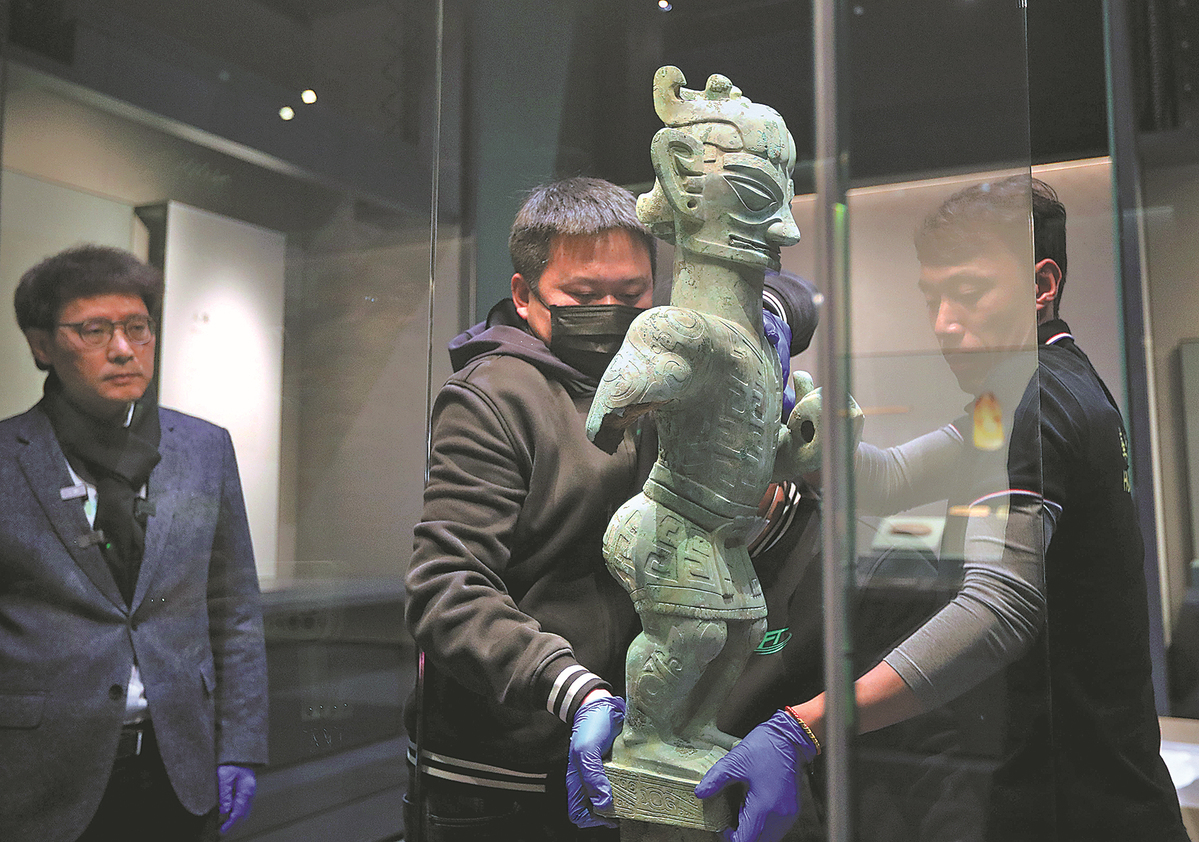
A standing bronze statue is moved into a cabinet for an upcoming exhibition at the Shanghai Museum ahead of the inauguration of a new venue in Pudong New Area. The statue, unearthed from the Sanxingdui Ruins in Sichuan province, demonstrates the high level of civilization in Sichuan some 3,000 years ago. LIU YING/XINHUA
During the recent Spring Festival holiday, China witnessed a notable surge in domestic tourism, with record-high expenditure spent on domestic travel.
Liu Jieyi, spokesman for the second session of the 14th National Committee of the Chinese People's Political Consultative Conference, emphasized at a news conference on Sunday that the surge reflects the significant consumption potential of the Chinese people, driven by a desire to enhance their quality of life, and is poised to become a strong driver of economic development.
The surge in tourism coincided with increased demand to visit museums during the holiday, leading to challenges for many individuals in securing tickets.
Museums have become a widely discussed topic, prominently featured during the provincial two sessions in many regions. Statistics from the National Cultural Heritage Administration revealed that last year, museums in China welcomed 1.24 billion visits, surpassing the 2019 pre-pandemic figure of 1.23 billion.
"The popularity of museums has not only recovered to the state before the pandemic, but also surpassed it," said Pan Shouyong, a museum expert at Shanghai University.
Further bolstering museums, progress has also been made in cultural heritage protection, archaeological studies and talent cultivation in this area, with China seeing "major progress made in the cultural heritage field in the last year", Li Qun, director of the National Cultural Heritage Administration, said at a national conference held in Beijing in January.
Pan worked with cultural heritage professionals at a seminar in February to evaluate the performances of museums in the last year, and has issued lists of the most influential museums and exhibitions based on their popularity.
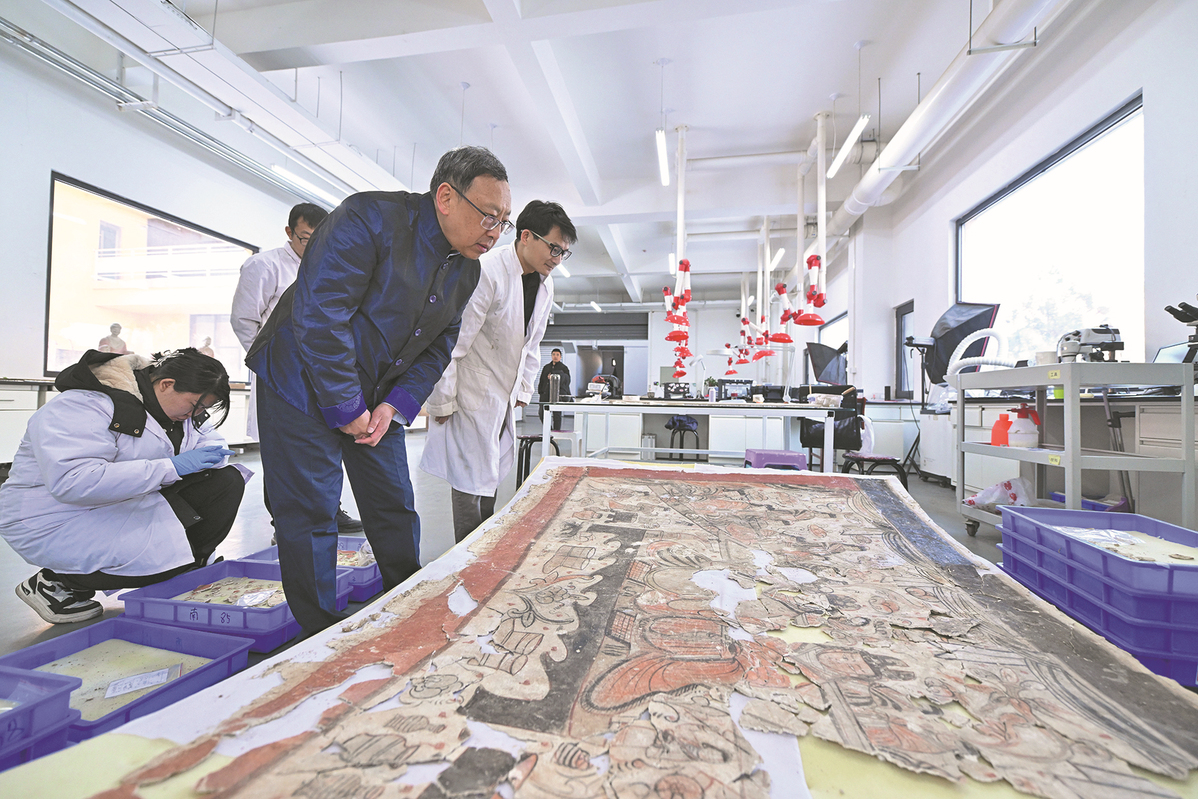
Hang Kan (second from left), head of the Yungang Research Institute, discusses methods of restoring wall paintings at the institute in Datong, Shanxi province, last month. ZHAN YAN/XINHUA
"Museums have become one of the most important tourist destinations for Chinese people," said Pan, explaining that people's demand for visiting museums surged last year, especially during the summer vacation when families flocked to museums.
"More than 200 of the 6,565 museums in China faced challenges of how to accommodate a great number of people in a short time. As a result, people might have found it difficult to book tickets," said Pan.
Moreover, people have become more demanding about the quality of exhibitions, and their themes have often been discussed online.
A highlight of the exhibitions last year was An Epic of Chinese Jade for 10,000 Years at the Nanjing Museum in Nanjing, Jiangsu province.
"The exhibition was well-acclaimed and popular. Jade has a long history in China and is distributed in places such as the Liangzhu city ruins near Hangzhou in East China's Zhejiang province, and sites of Hongshan culture in Northeast China. This display showed them together and covered the development of Chinese jade from 10,000 years ago. It means researchers at the museum did a lot of research on the subject," said Pan.
Visitors are increasingly pursuing an immersive experience when visiting museums, according to the expert.
"The China Grand Canal Museum in Yangzhou, Jiangsu, has been extremely popular. It's not known for its exhibits, but for its interactive activities. You can also find many visitors, and not limited to young people, wearing traditional Chinese costumes at the museum. The trend has been followed by people at other museums, becoming a ceremonial and popular way of visiting museums now," said Pan.
However, he pointed out the uneven popularity of museums in China, saying except for the more than 200 popular museums, others, even some at the national or provincial level, did not see a significant growth in visits last year.
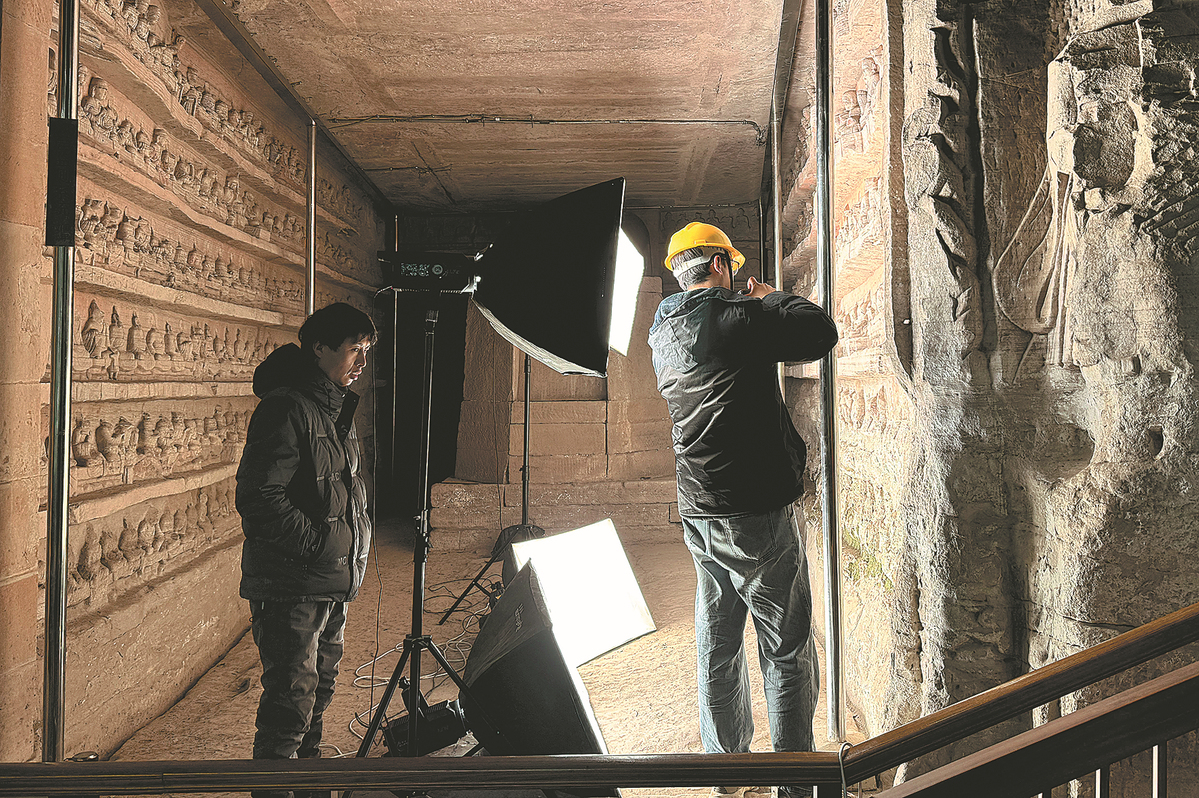
Archaeologists preserve and restore sculptures at the Dazu Rock Carvings in Chongqing in January. DU LIANYI/CHINA DAILY
Protection efforts
Officials and experts have illustrated attempts to protect cultural heritage across the country. A major one was the start of the fourth national census of cultural relics in November.
According to Zhang Wenrui, director of the Hebei Provincial Institute of Cultural Relics and Archaeology, this census is being conducted 12 years after the previous one.
"Since the relics are often located out in the open or buried underground, they may have disappeared or changed due to the influence of human activities. As a result, the census is important to provide a reference for our future protection efforts," said Zhang.
According to Deng Chao, director of the artifact and historical site department of the National Cultural Heritage Administration, this census is different from the previous three as publicity departments at different levels have jumped on board this time to help the cultural heritage authority accomplish the tasks.
All ancient architecture, sites, tombs, cave temples and carvings made before 1911 will be covered in the census.
At the same time, efforts to crack down on criminals threatening the safety of cultural relics and heritage sites have been intensified.
"The number of criminal cases related to cultural relics has dropped by 43 percent, from 2,300 in 2020 to 1,300 in 2023. And the number of accidental fires at heritage sites decreased from 15 to five in the past four years," said Chen Peijun, director of the supervision department of the National Cultural Heritage Administration.
He stressed the role of technology in protecting such sites, and said all key historical and cultural sites under national-level protection will be installed with satellite remote sensing for monitoring and law enforcement by 2026.
"Shandong and Zhejiang provinces and Shanghai have started monitoring with satellite remote sensing. Other provinces should follow suit and cooperate with natural resources authorities to promote the sharing of such technologies," said Chen.
Wang Wanfu, a deputy to the 14th National People's Congress who is also deputy director of the department of conservation research at the Dunhuang Academy, proposed to establish a National Key Laboratory on the protection of cultural heritage.
"China has abundant cultural heritage resources of various types, which face threats from the environment and others," said Wang on the sidelines of the second session of the 14th NPC. "As a result, I hope to establish such a laboratory to gather top professionals so that they can study and tackle the bottleneck problems in the protection of cultural heritage and support the development of this industry."
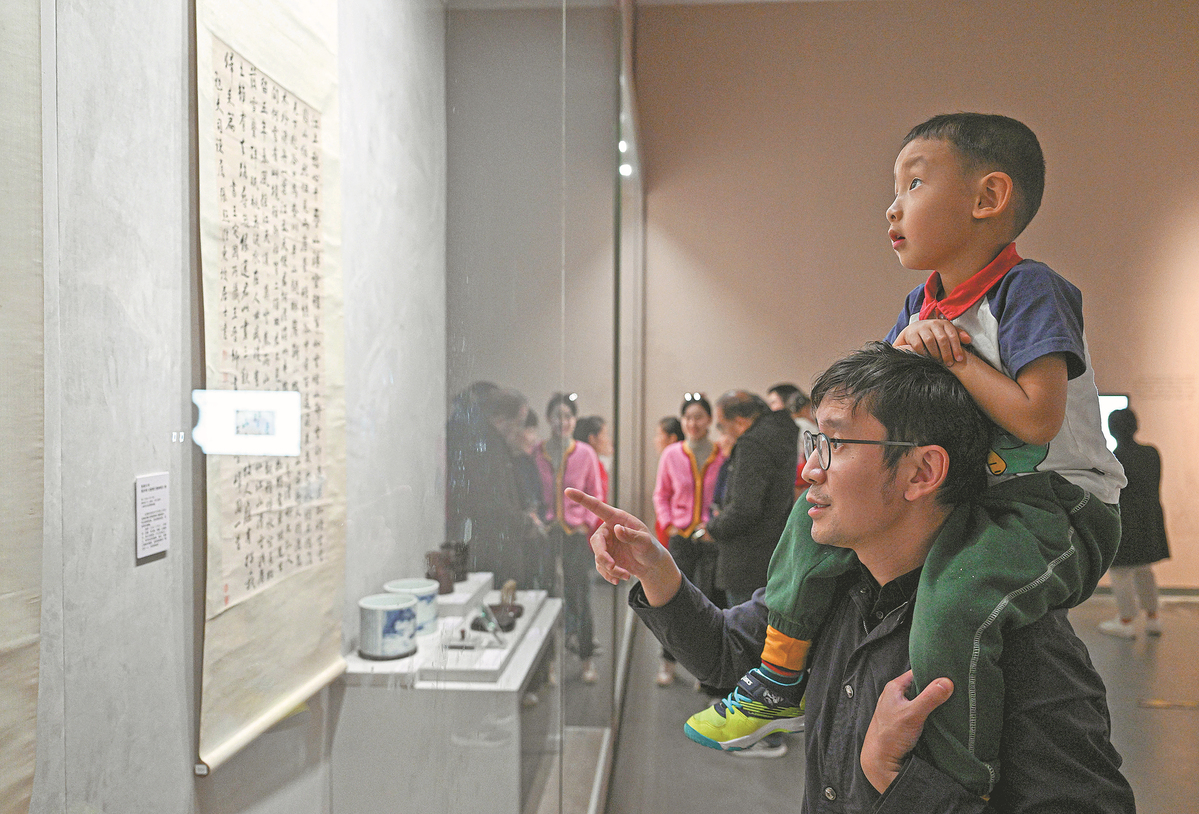
A calligraphy scroll attracts the attention of visitors during an exhibition for poet and calligrapher Su Shi (1037-1101) in the Hainan Museum in Haikou, Hainan province, last month. PU XIAOXU/XINHUA
Archaeological studies
Since 2002, the Chinese Academy of Social Sciences has issued an annual honors list of the six most important archaeological finds in China last year.
In this year's list, experts said the Mengxihe Site in Ziyang, Sichuan province, stood out as a Paleolithic site with especially rich material and remains of human activity. A series of Neolithic sites along the coast of Fujian province indicated the origins of Austronesian peoples. Excavations at the Qujialing Site in Jingmen, Hubei province, enriched understanding of prehistoric people's water management systems.
Moreover, the large-scale Shang Dynasty (c.16th century-11th century BC) tombs at the Zhaigou Site in Qingjian county, Shaanxi province, revealed possibilities of the existence of local states, which coexisted with the central Shang regime. Nestorian temple ruins at the Xipang Site in Turpan, Xinjiang Uygur autonomous region, are evidence of cultural exchanges on the ancient Silk Road. Excavation at a large architectural site south of the Shangjing city ruins of the Liao Dynasty (916-1125) promoted understanding of the Liao capital.
These sites were chosen from 265 active archaeological excavations and 1,367 excavations in preparation for urban construction projects carried out in the last year, according to Chen Xingcan, a member of the 14th National Committee of the CPPCC. He is also the head of the Chinese Academy of Social Sciences' Institute of Archaeology.
"The six programs have a large time span and wide geographical ranges. We chose them according to their academic significance. For example, the Mengxihe Site is a rare example not only in China's Paleolithic archaeology, but also in that of the whole world. The origin of Austronesian peoples is not only important for China, but has worldwide significance," said Chen Xingcan.
According to him, in the last year, major programs like Archaeology China and a program to trace the origins of the Chinese civilization continued to yield new progress. Studies on "the formation and development of China as a country with multiple ethnic groups" continued to deepen.
"The pace of 'going global' in China's archaeology is increasingly solid and steady, with rapid developments in archaeometry (scientific methods and technology used in archaeological study), and underwater archaeology. Moreover, a number of high-quality TV programs on archaeology have been produced and broadcast, expanding its social influence," said Chen Xingcan.
Technologies used to analyze human bones have unveiled the historical landscape of the formation, development and integration of various ethnic groups in ancient China. Their use in zooarchaeology constructs a framework for understanding the origins of domesticated animals in China and the ways in which animal resources were obtained and utilized, he added.
Important progress has been made in underwater archaeology after Chinese archaeologists explored two shipwrecks deep in the South China Sea last year, unveiling commercial and cultural exchanges along the ancient Maritime Silk Road during the Ming Dynasty (1368-1644), according to Song Jianzhong, a researcher at the National Center for Archaeology.
"China has built up its strength in archaeology. This has driven innovations in China's archaeological theories and technical capacities, established the disciplinary, academic and discourse systems for Chinese archaeology, and offered archaeological wisdom and strength to the construction of modern Chinese civilization," said Liu Guoxiang, deputy director of the Chinese Academy of History.
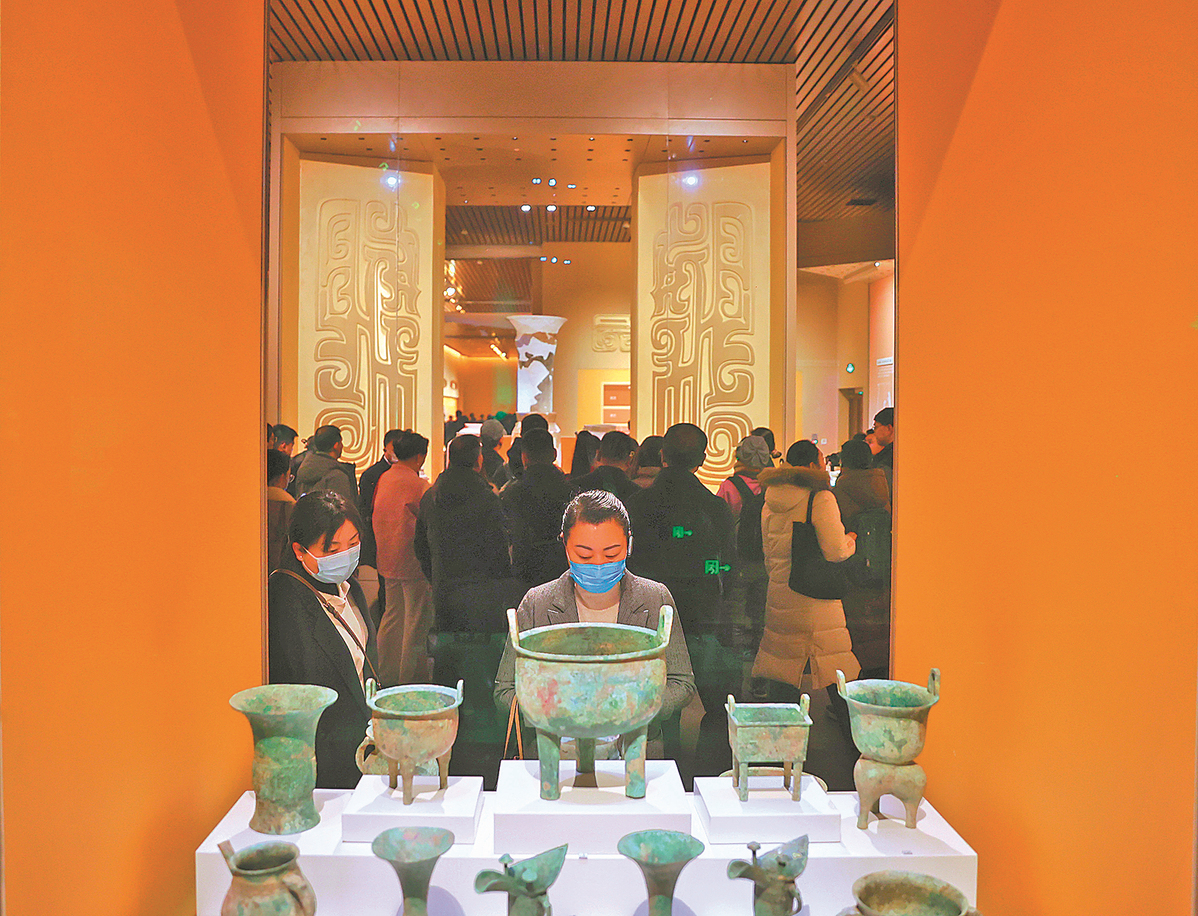
Visitors tour an exhibition hall of bronzeware at the Yinxu Museum in Anyang, Henan province, last month, as the museum officially opens. JIANG DONG/CHINA DAILY
More talent needed
With a growing emphasis on cultural heritage work, a lack of talent has become a major concern attracting the attention of some NPC deputies.
Hang Kan, a deputy to the 14th NPC, who is also director of the Yungang Research Institute in Datong, Shanxi province, suggested that cultural heritage courses be better arranged at universities and efforts increased to cultivate more people who will support the protection of cultural heritage in China.
According to Deng, the cultural heritage official, among all the 760,000 immovable cultural heritage sites, more than 400,000 are architecture. However, only 737 professionals are engaged in the protection and research of ancient architecture in China, which means there is only one professional per more than 550 sites.
To tackle the problem, cultural heritage authorities and institutes at the national, provincial and lower levels have increased the number of positions with stable social security and health insurance to attract more people.
"China has so many sites, archaeological programs and museums, but only several thousand qualified archaeologists and less than 200,000 museum professionals. There is a huge demand in this area," said Pan.
"Moreover, a person's growth in this area is slow and accumulative. They may find it difficult to see their progress in just several years' work. Only after decades can they become experts. As a result, this arrangement leaves room for their growth," he added.
He pointed out that since interdisciplinary research is required in cultural heritage work, people specializing in different areas are needed.
"Generally speaking, cultural heritage majors now have more opportunities. Most of them can find a job suited to their training at universities. But their income still needs to be raised, or such jobs are less appealing compared to other professions like teaching."
Pan said the lack of talent is especially outstanding in grassroots areas, where a large number of cultural heritage sites are actually located. But few graduates want to work in these places.
He highlighted a program being carried out in Shanxi to cultivate cultural relics professionals from 2022 to 2027, which provides students with free education and requires them to work in city, regional, county and lower-level cultural relics protection institutes in the province after graduation. The expert hoped more measures could be taken to tackle this problem.
Edit:董麗娜
The copyright of the article and the picture belongs to the original author. If there is any infringement, please contact to delete it